The Best Real Estate Investment Isn’t Always in the Best Neighbourhood
Why overlooked neighbourhoods, everyday businesses and long-term tenant loyalty can create better investment opportunities than prestigious locations.
Everyone tells you to buy in the best neighbourhood you can afford.
I disagree.
In commercial real estate, some of the best investments I’ve seen haven’t been in the neighbourhoods everyone talks about. They haven’t been the newest developments, the most attractive retail centres or the properties sitting on the most prestigious streets.
They’ve been in ordinary neighbourhoods, serving ordinary people, with businesses that quietly generate income year after year.
And there’s a reason for that.
The Problem With Following the Crowd
When a neighbourhood becomes highly desirable, everyone knows it. Investors know it, developers know it, brokers know it, and institutional buyers are usually paying attention.
That popularity comes at a price.
Competition drives acquisition costs higher. Cap rates can become compressed, and investors often find themselves paying a premium for what they believe is a safer investment.
But is it really safer?
A great-looking property purchased at the wrong price can become a mediocre investment. A prestigious address doesn’t automatically translate into better tenants, stronger cash flow or a superior long-term return.
I’ve always believed that the quality of an investment should be measured by its fundamentals, not by how impressive the address looks on a presentation.
You make your money when you buy, not when you tell people what you bought.
The Value of the Everyday Neighbourhood
Consider two retail properties.
One is located in an affluent, highly sought-after neighbourhood. It has attractive surroundings, modern architecture and plenty of investor interest.
The other is in a working-class or middle-income neighbourhood. It’s not particularly glamorous. The building may be older, and the surrounding streets may not attract much attention from outside investors.
Now look at the businesses operating in each location.
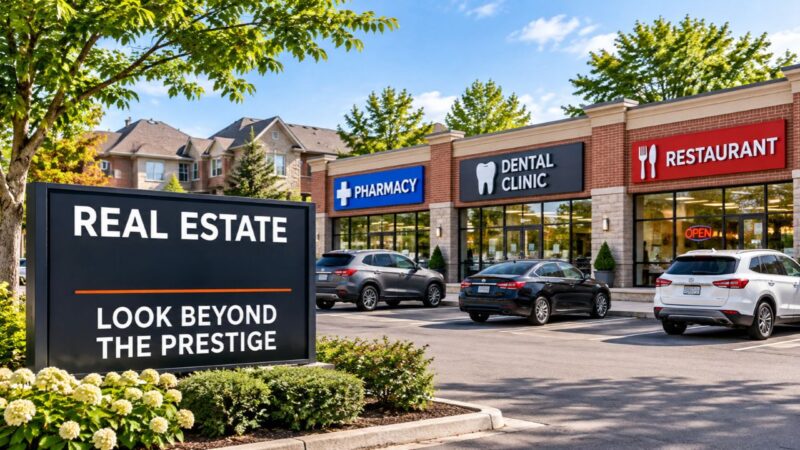
In the second neighbourhood, you might find a pharmacy, a dentist, a convenience store, a takeout restaurant, a medical clinic and a local service business.
These are businesses that serve people who live nearby. Their customers return regularly. They build relationships. They become part of people’s routines.
A family might visit the same dentist for fifteen years. Someone might pick up prescriptions from the same pharmacy every month. A local restaurant might serve the same customers several times a week.
That creates something investors should pay close attention to: repetition and loyalty.
These businesses don’t necessarily need a fashionable neighbourhood. They need a reliable customer base, convenient access and a location that makes sense for the people they serve.
And when the businesses are successful, they have a reason to stay.
Tenant Stability Is More Important Than Prestige
One of the biggest mistakes I see investors make is focusing too heavily on the physical property and not enough on the businesses inside it.
A building is an asset, but its income depends on its tenants.
A beautiful retail centre with constant tenant turnover can become an expensive management problem. Every vacancy brings lost rent, leasing commissions, tenant improvements, legal costs and uncertainty.
Compare that with a well-located neighbourhood plaza where tenants have established customer relationships and have operated successfully for years.
The second property might not win an architectural award, but it may deliver something much more valuable: predictable income.
This doesn’t mean every working-class neighbourhood is a good investment, or that every affluent neighbourhood is overpriced. It means investors need to look beyond appearances.
Tenant quality, lease structure, local demographics, competition, accessibility and acquisition price all matter.
The right combination can create a remarkably resilient asset.
Follow the Fundamentals, Not the Headlines
When evaluating a commercial property, I ask questions that have very little to do with whether the neighbourhood is considered desirable.
Is the population stable or growing?
Are households and families staying in the area?
What services do residents need regularly?
Is there a healthy mix of established local businesses?
How much competition exists from similar retail properties?
Can tenants afford the rent and operate profitably?
Is the purchase price justified by the property’s actual income?
These questions tell me much more than a neighbourhood’s reputation.
Demographics are particularly important. A growing population, established residential communities and limited availability of convenient retail services can create a strong foundation for neighbourhood commercial real estate.
You don’t necessarily need explosive population growth. Sometimes a stable community with predictable spending habits is exactly what an investor should be looking for.
The opportunity is understanding what the neighbourhood needs today and what it will continue to need ten or twenty years from now.
Buying Value Requires Patience
There is another advantage to looking where other investors aren’t looking: you may have more room to negotiate.
When ten buyers are competing for the same trophy property, the seller has leverage. When fewer investors recognize the potential of an overlooked location, a disciplined buyer may have an opportunity to acquire the asset at a more attractive price.
But buying at a discount isn’t enough.
I still want to understand the building’s condition, deferred maintenance, operating expenses, tenant mix, lease expirations and realistic rental potential.
I also want to know what happens if one of the major tenants leaves. Can the space be leased to another business? Is there sufficient demand? Does the property have the flexibility to adapt?
A good investment isn’t simply one that looks inexpensive. It’s one where the purchase price, income, operating costs and long-term potential make sense together.
Patience matters, too. Commercial real estate isn’t always about buying something today and selling it tomorrow. Some of the best assets are built through years of careful ownership, tenant relationships and disciplined management.
The Long-Term Investor Sees Something Different
I’ve learned that the most interesting opportunities are often hiding in plain sight.
Investors frequently chase what is already popular. They want the address everyone recognizes, the development everyone discusses and the property that looks impressive in a portfolio.
I understand the appeal.
But I’ve always preferred understanding what makes a property economically sustainable.
A neighbourhood pharmacy doesn’t need a fashionable address to serve its customers. A dentist doesn’t need a luxury retail centre to build a loyal patient base. A neighbourhood restaurant doesn’t need to be surrounded by expensive buildings to become part of people’s daily lives.
These businesses need customers, convenience and a location that works.
And the property owner needs to recognize that value before the rest of the market does.
The trophy building might impress everyone at the closing dinner. The ordinary neighbourhood property might quietly outperform it for decades.
That’s the difference between buying a location because everyone wants it and buying a property because you understand why it works.
I would rather own a well-positioned, income-producing property in a neighbourhood with loyal customers and sustainable demand than overpay for prestige.
In the end, real estate investing isn’t a popularity contest.
It’s a business of understanding people, recognizing value and having the discipline to invest where the fundamentals make sense.
Don’t just buy the best neighbourhood you can afford. Buy the best investment you can understand.